Showing posts with label Red-bellied Pitta. Show all posts

New Birders, New Pitta, New Friends

Last Sunday, the WBCP partnered with the UP Mountaineers (UPM) and organized a guided bird watching trip for UPM applicants in the Ninoy Aquino Parks and Wildlife in Quezon City. The group of 50 applicants were divided into five birding groups led by WBCP guides and saw more or less 10 birds in the park.

Jops giving the introduction to the activity to lots of possible new birders!

Of course, birding is not for everyone but there were some really interested people in the group who I hope will continue birding after that weekend. We had to end the bird walk at 9AM since the applicants still had a tree walk to do, to be led by the Philippine Native Plants Conservation Society. I really wanted to join the tree walk, as I've been wanting to learn more about how to identify trees but Jops and I promised to meet James M. and his family in the La Mesa Ecopark that morning. We invited our fellow guides to join us and of course they said yes!

Off to La Mesa we went. I went straight to the spillway to try to see the Plaintive Cuckoo (would be a lifer!) our friends Adri and Trinket spotted the last time they were there. Unfortunately, the cuckoo wasn't there and we decided to go into the park where we fortuitously bumped into James and his family! We all trooped to the mini-forest where we saw an immature Red-bellied Pitta busily foraging for food.

The immature pitta just starting to develop the red color
in splotches across its belly
It posed very kindly for quite a while... with its back turned =P
A new pitta addition to the LMEP mini-forest

We moved around the trail, looking out for more birds. The muggy weather didn't make it an ideal morning for lots of birds but we did see an Ashy Ground Thrush scurrying about and tending its nest. It looks like the Ashy's are breeding almost the whole year round despite all the human traffic and, at times, human disturbance from getting too close to nests.

Ashy Ground Thrush - always a star in the mini-forest
Sitting on its nest very close to the trail, hopefully it will be observed and
photographed FROM the trail and not from inside the trees

We observed the bird for a few minutes before saying our goodbyes and moving away from the nest. It was almost noon and we all had to leave. Even with just a couple of hours birding, we were happy with the sightings of two awesome birds. It was such a pleasure meeting and birding with James, Natalie, and their kids. James is one of the founders of the WBCP and it was an honor to meet and bird with him =) It was their first time in the park and seeing their reactions upon spotting the birds (especially the kids!) made me realize again how lucky we birders are to have this patch of green in the middle of the city and so close to home too.

Birding with new friends, James, Natalie, and kids,
in the LMEP mini-forest

Forest Bird, City Bird

A few months after Jops and I became birdwatchers we were lucky enough to have gotten big birding "breaks" that allowed us to see birds that were quite difficult to see before. I think it started with the Ferruginous Flycatcher that made an appearance in the UP Diliman campus way back in November 2010. That was our first ever twitch and we didn't know how lucky we were to see it so close to home. (Here's Trinket's blog post about it =) )

Our next lucky break was the Naked-faced Spiderhunter which was chanced upon by a bird photographer in the La Mesa Ecopark in December 2010. This got the ball rolling for the park, bringing in more birders and bird photographers and leading to more and more avian discoveries: Red-bellied Pitta, Hooded Pitta, Brush Cuckoo, Ashy Ground-Thrush, Mangrove Blue Flycatcher, Rufous Paradise Flycatcher, Guaiabero, Grey-backed TailorbirdSlaty-legged Crake, Scaly Ground-Thrush... the list goes on. Who knew the mini-forest housed so many birds! 

Jops and I visited the park last Friday afternoon to check out something in the mini-forest. We weren't expecting anything bird-wise given that we just had a few hours before it got dark, but we were still hoping to see the Pechora Pipit. 

It was a nice, quiet weekday and there weren't that many people passing through the park. A very friendly Red-bellied Pitta showed up shortly after we entered the trail, busy foraging on the ground.

A very plump Red-bellied Pitta stayed close to the trail giving us
excellent views and allowing us to photograph it.

Another friendly bird, a male Mangrove Blue Flycatcher, also kept giving us very close encounters, perching very near us at the edge of the trees.

Male Mangrove Blue Flycatcher kept surprising us with its appearances!

After a while, I saw some movement on the ground... a small brown bird with streaks was walking around the area. The Pechora Pipit! It was walking a bit slowly at first but then became more active as it foraged on the ground.

A blurry photo of lifer # 236 - Pechora Pipit

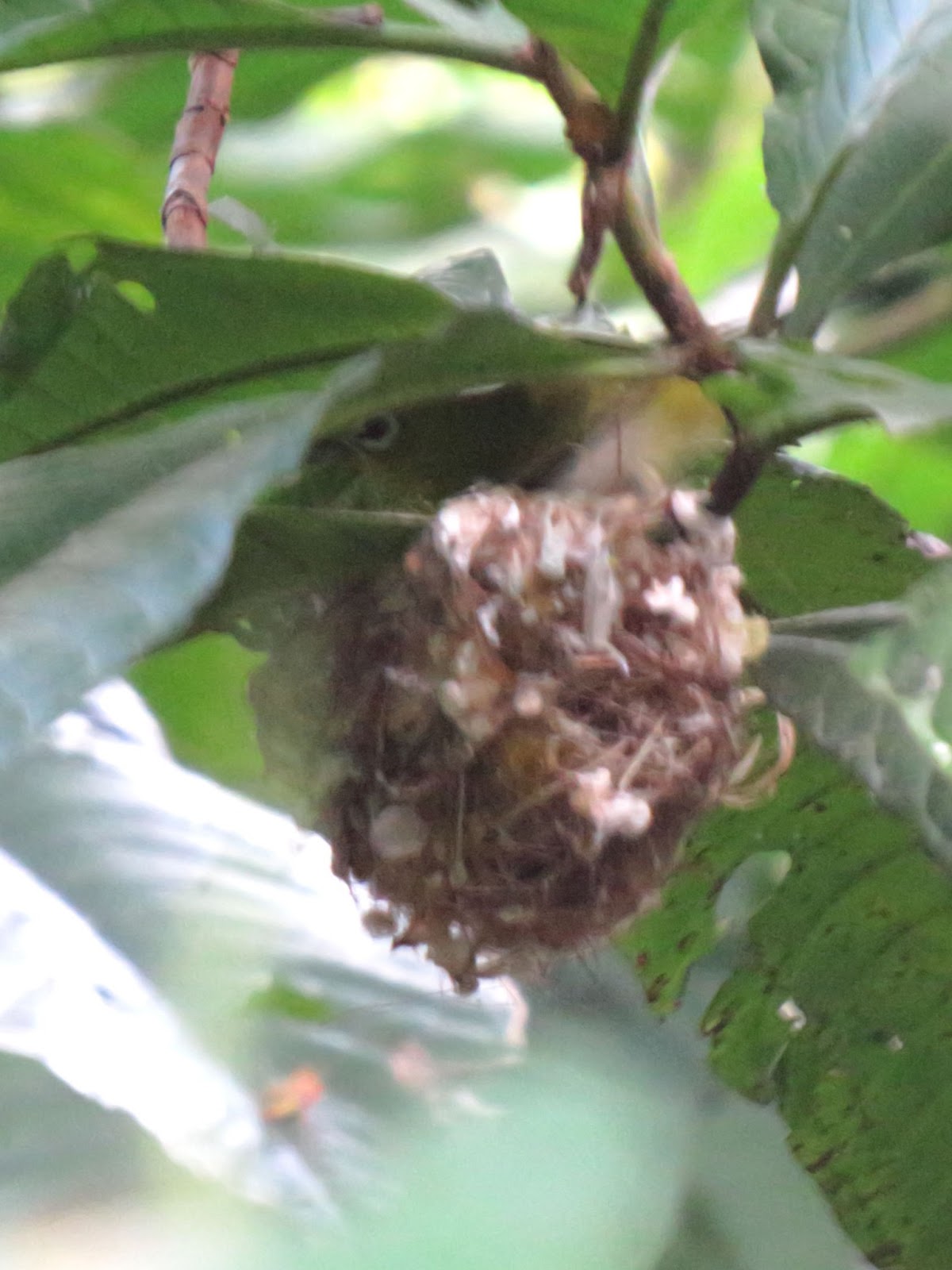
Also along the trail, we spotted a Lowland White-eye nest. The adult bird would make occasional visits to the nest but we did not see any chicks yet. The bird soon flew away after only a few seconds on the nest.

Lowland White-Eye on its nest

A group of noisy teenagers passed through the trail with matching blaring music from a cellphone. I stepped out of their way and let them pass before resuming my observation of the nest. Seeing the nest and remembering where I was made me realize how blessed I am to be able to witness this in the middle of the city -- how blessed and lucky us birdwatchers are to have access to these kinds of birds in Quezon City.

I remember some friends telling me and Jops that we didn't seem to realize how lucky we were to be able to spot the Ashy Ground-Thrush in the mini-forest when most birders have spent countless hours before dawn, up the trail in Mt. Makiling just to spot it. Yes, we didn't realize it at that time. And once we heard the stories from other birders, we did realize how lucky we and a lot of birders are to see it. The whole experience became more meaningful and memorable. 

Thinking more about the wonderful discoveries birdwatchers have had in the park, it made me think about how amazing it is that these forest birds have found a home and suitable habitat in this mini-forest in the middle of the city, how they have been thriving there possibly way before us birders "discovered" them, how they have survived even with the lack of awareness of their presence from the park administration and staff, and how they are able to continuously breed successfully with all the human traffic, intrusion, and noise around them. Amazing. 

Thanks to the efforts of birdwatchers, the park has now become more aware and conscious of the birds' presence. They may not be able to differentiate and appreciate the rarities and unique species in the park (just like we had in the beginning), but now they know that the mini-forest serves as a home and breeding ground for most of the birds and they have shown understanding and appreciation for that. Slowly, just like us, they will learn the real value of the birds and the park.

The Scaly Thrush Teaches Me A Lesson

It was the first time I really felt frustrated with the lack of birds. My companions and I were in the La Mesa Ecopark for some post-Christmas birding and I was hoping for the best. The park wasn't so full and the trails were almost deserted except for us and the occasional passerby. But all we saw after a couple of hours birding were Black-naped Orioles and Brown Shrikes. Good thing we saw an Osprey in flight on our way into the trail. 

We moved further into the trail hoping to see the Red-bellied or Hooded Pittas, but the surroundings were so quiet. A light rain would fall in intervals, alternating with songs from unseen Golden-bellied Flyeaters and yes, more Orioles. Good thing the Ashy Ground-Thrushes were a bit active that morning or else I would have felt really down.

We rounded the trail without seeing any additional birds. No Mangrove Blue Flycatchers. No Tailorbirds. No Crakes. No Pittas. Not even a Yellow-vented Bulbul! I was really beginning to feel sad. I decided to take our birder friend, Tinggay's advice to actually talk to the birds. I did (quietly.) I talked to the Red-bellied Pittas hiding in the brush to show themselves even for a few seconds. They didn't.

By this time, I was feeling really sad already so when it was suggested that we leave the trail to bird somewhere else in the park, I just pouted and followed my fellow birders as they started walking out the trail. There wouldn't be any more birds this morning.

It was then when a bird decided to teach me a lesson: no matter how frustrating and hopeless a situation may seem, God has something much, much better in store for you.

Walking out the trail, I saw what looked like a gigantic wader atop a fallen log. It flew off into the trees as soon as we stopped to take a better look. We followed it and saw a huge bird foraging on the ground. It was speckled... the spots looking like burnt fish scales. That's when it hit, we were actually looking at a Scaly Ground-Thrush (White's Thrush).


It was very easily flushed, flying off even when we were standing really still. I wasn't able to take a docu shot of my lifer before it flew away. Along the trail, we bumped into Bram and Kath. While we were waiting and scanning the area for the larger thrush, Bram saw a Red-bellied Pitta who apparently decided to answer my request earlier that morning and posed for their cameras. 

I guess talking to the birds really helps. I started talking to the Scaly Ground-Thrush (White's Thrush), this time asking permission for us to photograph it. We saw it one last time, perched a few meters above the ground, before we finally headed out the park. 

Thank you, Scaly Ground-Thrush, for teaching me the lesson I needed to learn the most =)