Showing posts with label Mangrove Blue Flycatcher. Show all posts

The Birds After the Storm

I like seeing bird’s nests. That’s a fact. I get excited whenever a nest is spotted because I marvel at the architecture and uniqueness of each nest. Imagine a bird building such structures with only their beaks and feet! Look ma, no opposable thumbs! How awesome is that?!

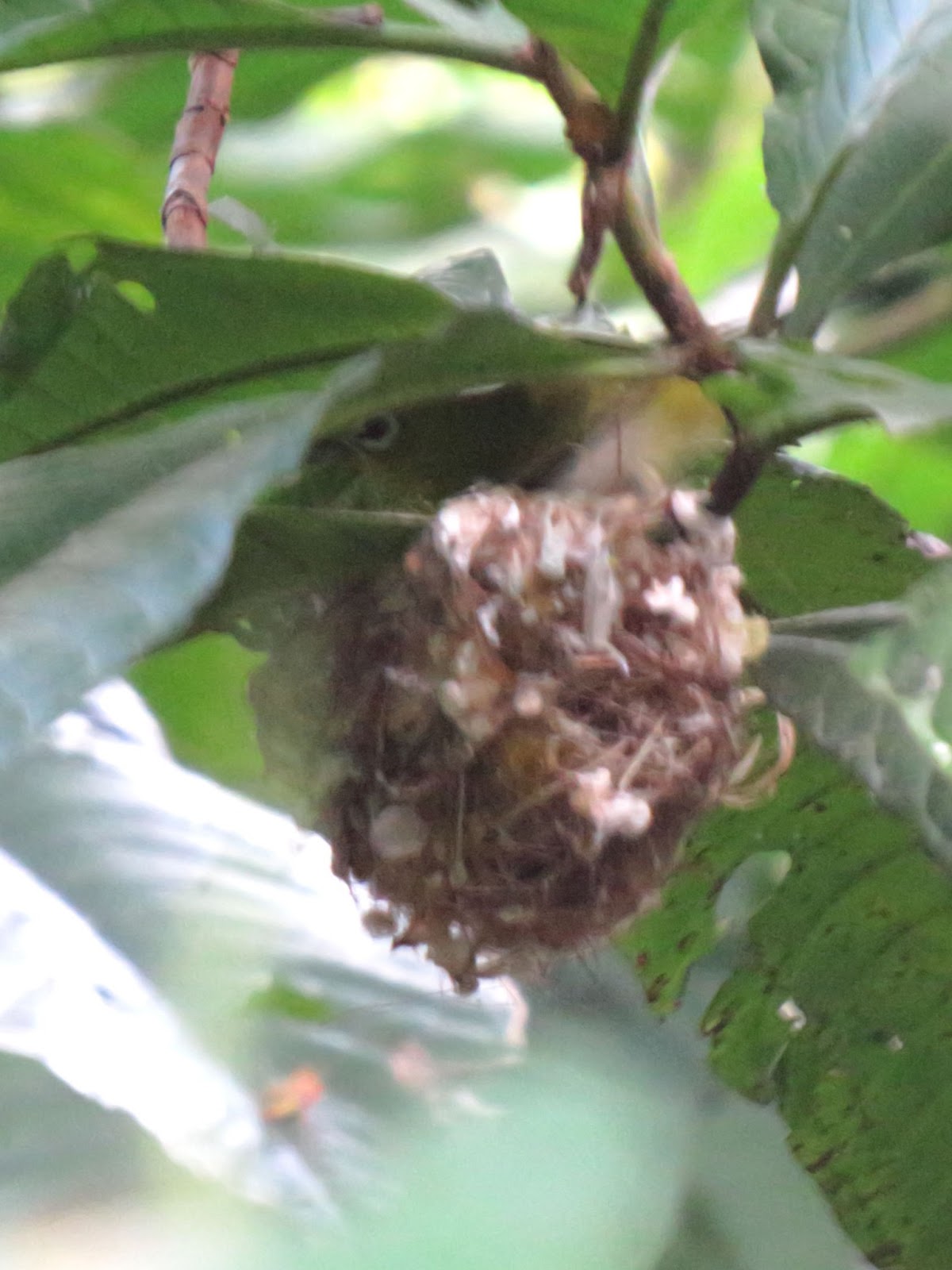
I’ve written a post a long way back about the nests I’ve seen so far. I’m happy to add another nest that Jops and I spotted earlier this month. I didn’t post any photos about it since it was clearly an active nest, with the parents flying in and out to feed at least two chicks in it. We were lucky enough to see a nest of a pair of Mangrove Blue Flycatchers!

We noticed both parents staying in one area bringing food in their beaks. We saw the male Flycatcher perch on the side of the nest, where two hungry beaks opened up to receive the food!! That's when we realized the hollow in a small tree trunk was the nest! Upon checking our field guide to confirm our observation, we were surprised to read that their nests in the Philippines haven't been described yet at the time of publication. So it was even more exciting being able to observe something first hand that is not in the field guide yet =)

The shallow hollow in the trunk was about 8ft from
the ground and filled with some nesting material


We returned to the site a number of weeks after and I admit I was quite wary of what we would find. Typhoon Glenda had just passed the week before and we were expecting considerable damage in the trails. I was curious to know if the nest and chicks survived the storm.

The trails have been cleared of debris, but the inner portions of the trail showed considerable damage to the trees and other plants. 

The trails were cleared but were bordered by fallen branches and trees
A lot of the younger trees were bent or broken after the typhoon

Before reaching the nest area, we saw quite a number of birds hopping around the mini-forest's floor. The Hooded Pittas were busy foraging and a pair of Red-bellied Pittas showed up as well. Photographing these birds while they are hopping and sprinting away are a challenge on any given day, but add to that all the fallen branches and brambles... almost impossible to get a clear shot!

Spot the pitta!
Blurred and headless! I love the bright red though =)

We approached the nest and didn't see any bird activity. I tried my best to peep inside using my binoculars and found the nest empty. My heart sank a bit as I considered the worst, thinking that the chicks didn't survive the typhoon. Then Jops was calling me to the other side of the trail: immature Mangrove Blue Flycatchers! There were two!

I hurried to where he was and took some time spotting the small bird singing among the trees. We saw some small movement and there it was, still sporting the scaly feather pattern I love!

Immature Mangrove Blue Flycatcher

It stayed singing on its perch while another one answered back unseen from further inside the trails. I am hoping these two were the chicks we saw previously in the nest and that they had successfully fledged, although I really have no way to be sure of that.

It transferred to a different perch and even flew down to the ground to pluck some food from the soil before flying up a branch again.

Another view of the young Mangrove Blue Flycatcher

I had previously only got some fleeting views of young Mangrove Blue Flycatchers so I was really happy with the long, unobstructed views we got that morning =)

I also got a close encounter with a plump male Emerald Dove which was perched right in front of me at eye level at the edge of the trail.

It stared at me as if daring me to move...
I didn't.

There was also a LOT of Lowland White-eyes in the trails that day as well as very vocal Grey-backed Tailorbirds, although I did not see any of them.

Spot the White-eye!

We were beginning to miss the Ashy Thrushes when we saw one bringing a big, fat, and still-wriggling earthworm in its beak!

Nom nom nom! Hearty breakfast!

Seeing the breakfast worm reminded us we hadn't had any breakfast yet! We made our way out the trail but not before we spotted three Philippine Pygmy Woodpeckers preening on a bare branch.

All lined up for take-off?
After preening, of course!

The woodpeckers were busy that morning as we spotted one more intently pecking away at a node of a tree. As it was working, it didn't notice a skink making its way slowly towards it! The skink left it alone after a quick peek.

Spot the woodpecker and the skink!


It was a short birding morning but I got to see the immature Mangrove Blue Flycatchers plus the pittas, thrush, woodpeckers, white-eyes, doves... our list was quite long! Even after a strong typhoon the birds are thriving and well, I guess I can take my cue from them =)
A Busy Time for the Mamas and the Papas

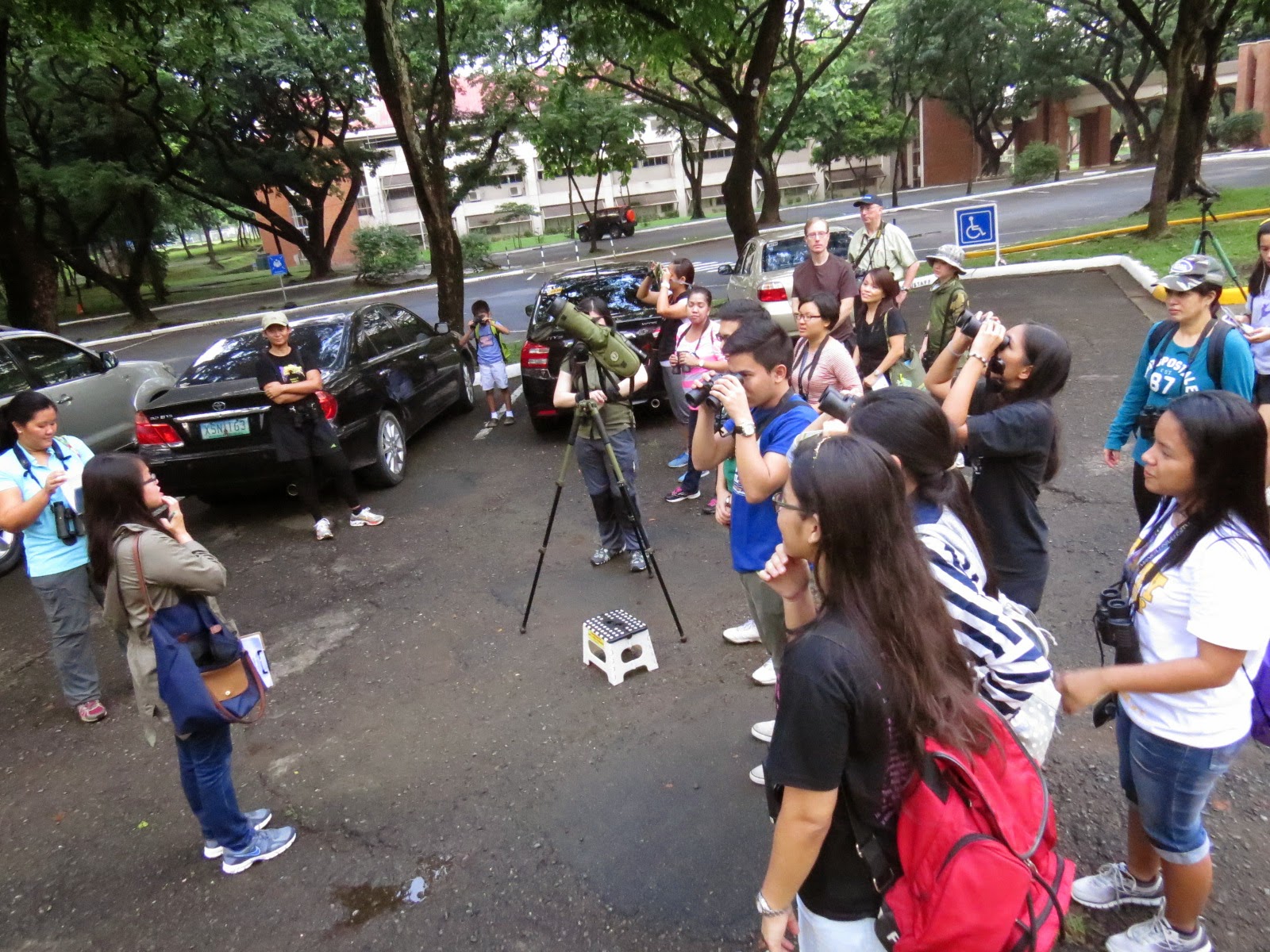
Jops and I were able to join a guided trip last Saturday and do a bit more birding after the official activity ended. We didn't get to see any new birds but the observations we got that day were pretty amazing.

As dark rain clouds rolled in, we began the birding activity and how lucky we were! Our group was standing just beneath a nest of some Olive-backed Sunbirds.

The group was standing under some trees and...
some busy sunbirds!

We saw a pair of Olive-backed Sunbirds and the first-time birders were treated to seeing the female sunbird tending its nest and even sitting in it! How's that for a first birding experience =)

The mama sunbird tended the nest and chicks
She then sat in the nest for a while before flying off again.
A big chunk of the nest seemed to be falling apart
at the bottom...

We saw most of the usual suspects in the area but the Long-tailed Shrikes that frequent the campus were mysteriously absent! We heard a couple of them but saw none that morning.

Jops and I continued our Saturday with a bit more birding and saw that the sunbird parents weren't the only one's busy tending to their young.

We saw lots of Lowland White-eyes that day and spotted one nest. I remembered the first time I saw a Lowland White-eye nest and marveled at its construction. The delicate cup-shape nest is perfectly rounded at the bottom and anchored on thin branches.

The parent bird would sit on the nest, leave, then come back to sit again.
Can you see it?

We also saw a very active Ashy Thrush plucking some earthworms from the ground before hopping away into the trees, most probably to feed its nestlings.


We also got a few surprise observations as we saw a Hooded Pitta with a mouthful of worms too! It stayed still with the worms wriggling in its beak before flying off with its catch. We would see it back in the same area again, digging for more worms.

A slightly wet pitta with some worms in its beak.
It was a such a dark, gloomy, drizzly afternoon!

We then had an encounter with a pair of Mangrove Blue Flycatchers perched together on a leafless tree. The mama soon flew off but the papa stayed behind. It would come back to the same area with food in its mouth, ready to be delivered to its nestlings.

The papa Mangrove Blue came back with spiders and worms!

The weather didn't improve much so Jops and I decided to call it a day. We just got a handful of birds on our list but we got great observations of bird behavior.

It is always so much more interesting and rewarding when we get to see the birds' natural behavior. Behavior that is not manipulated in any way using any supplements or reinforcements. There is a different kind of joy in this kind of experience, knowing we were exactly at the right place at the right time with the birds =)

El Nido Adventure: Final Hurrah and the Mystery Blue Flycatcher

I woke up early Saturday morning, decided to make the most of the one or two hours we had before we boarded our plane and left El Nido.

Nature has the most awesome colors!

Our first day was a great exploratory adventure and I was able to see 8 lifers. Our second day wasn't as birdy but we were lucky enough to have spent an hour in Lagen island (huge thanks to Noel B. for the generosity!) where I added more lifers bringing my total El Nido lifers to 12! I wasn't expecting any lifers on our last morning in El Nido Cove, but I did want better views of one of my lifers, the Stork-billed Kingfisher.

The sea and beach was very calm early in the morning

Jops and I walked to the far end of the beach to the area where we saw the kingfisher two days ago. Jops was able to spot it on a leafless tree through the spotting scope on our first morning in El Nido Cove. While walking, we spotted a Little Egret feeding in the shallows and an Osprey flew past over the sea.

Soon we were near the leafless tree and, hiding under the leaves of a talisay, we waited for the kingfisher to show. It did but was quite shy and very sensitive to any movements we made. I was able to get a photo of it hiding behind a tree trunk =P

Handsome Stork-billed Kingfisher

The kingfisher disappeared from view but would come back to perch on a different tree on the beach a number of times. In between these appearances, a number of other birds showed themselves.

A couple of Thick-billed Green Pigeons landed on a fruiting ficus tree, quickly disappearing into the thick branches as they fed. A Grey-streaked Flycatcher also decided to perch very close to us and stayed unmoving on its exposed perch.

Grey-streaked Flycatcher

A pair of Rufous-tailed Tailorbirds also came out into the open and surprisingly stayed quite a while, flitting from perch to perch. On of them perched just in front of us an stayed put long enough for a mini photo shoot!


Some Palawan Bulbuls also joined the tailorbirds in the brush but didn't show very well. The very common Asian Glossy Starlings also started to become active around us and a pair of Brown-backed Needletails soared overhead. A Collared Kingfisher also made a brief appearance. Soon, it was time for us to walk back to the resort for our breakfast before going to the airport. We said goodbye to Marco, the manager of El Nido Cove, and thanked him for our wonderful stay.

Group shot on the deck!

Soon, we were in the van heading towards the airport. After depositing our luggage and checking in, we decided to check out the mangrove area behind the huts as a final birding hurrah. We heard a flycatcher singing and soon spotted a handsome blue flycatcher perched on the mangrove roots! We got all excited at the possibility of it being a Palawan Blue Flycatcher, another would-be lifer to bring my total to 13! The Palawan Blue Flycatcher looks extremely like the Mangrove Blue Flycatcher, so we took lots of photos and the bird posed beautifully for us.

Mangrove Blue Flycatcher

Alas, upon checking and consulting our friends, and with the help of our friend Christian (who has seen and photographed both the Palawan Blue and Mangrove Blue Flycatchers), we were able to identify the bird: it was a Mangrove Blue Flycatcher.  Not a lifer, but I did get a pretty good picture =) 

My life list for El Nido remained at 12 which was a bonus in itself.  On top of that, we also got to meet lots of super nice people, fledged a few more birders, and added lasting memories from our trip. I can't wait for the next adventure!

Slow Birding But With Perks!

Jops and I scheduled a quickie birding morning at the La Mesa Ecopark with friends Tito Bob and Tito Chin. It was raining hard the night before but we decided to push through the next day and we were rewarded with a rain-free morning.

It was a bit difficult spotting the birds in the mini-forest. We caught a glimpse of a Red-bellied Pitta but it hopped out of view almost immediately and didn't show itself again. No Hooded Pittas either. An Ashy Ground Thrush would hop around the dark undergrowth, unmindful of a foraging Common Emerald Dove and a group of chickens scratching at the wet soil.

Handsomely speckled Ashy Ground Thrush

We all went our separate ways in the mini-forest, I'm sure with different target birds in mind. I personally wanted to see (and try to) photograph a Grey-backed Tailorbird. They were singing loudly in one patch of trees and I immediately saw some movement. There were three Tailorbirds chasing each other around, but they would not stay put long enough for me to even focus my camera on them. It was a bit frustrating firing some shots and only to find you got a sharp enough photo of the bird's perch... without the bird. Sigh. I just contented myself with superb, in-your-face views of the Tailorbirds instead.

Jops went in search of the Slaty-legged Crake which snuck up behind him the last time we were in the park. I caught up with him but he unfortunately didn't see the bird. We did get our wish to see an immature Mangrove Blue Flycatcher though! Unfortunately, we didn't get any photos as it was continuously hopping from one branch to another and flying from one side of the trail to the other. We did get to see the adult bird and it posed beautifully for a photo.

This adult Mangrove Blue Flycatcher sang a bit on this branch
before flying off into the trees

The Lowland White-eyes were still busy building nests. We observed at least two nests being built, the birds coming and going, trying the nest on to see if it is snug enough (as in the bird would sit in it) before flying off in search of more nesting material.

A blurry photo of a Lowland White-eye "trying on" its nest

Towards mid-morning, we got a text from Tito Chin saying that he and Tito Bob would be leaving already. Jops and I decided to do the same but of course, bird along the way out of the trail. We were sidetracked by a very bold Grey-backed Tailorbird who inspected the nest of the Ashy Thrush. It managed to actually enter the nest before mama (or papa) Thrush landed on the nest and drove it away. The mama (or papa) Thrush then shimmied itself onto the nest before it left again.

Jops and I were really curious about the behavior of the Tailorbird. We decided to wait a bit and see if the small bird would come back to the nest. We positioned ourselves a distance from the nest and waited. The Tailorbird did not come back, but the mama (or papa) Thrush did and with a mouthful of worms! It was feeding time! Immediately, three beaks shot up into view from inside the nest, waiting for the plump worms to be deposited into their mouths.

Breakfast time! Or was it a morning snack?

The parent then suddenly picked up a fecal sac and swallowed it! It was so cool to watch! Actually, if you come to think of it, it is a bit gross. Fecal sacs are whitish mucous membranes which surround the feces of most nestlings. These are produced almost immediately after the chick has been fed. Not all bird species produce fecal sacs, mostly passerines, and not all the time do the parents eat them even though they are believed to have some "nutritional value" for the adult bird. Most of the time, and when the chicks are older, the adult bird picks up the fecal sac and removes it from the nest. This keeps the nest very tidy and ant-free!

We were lucky enough to have the Ashy Thrush come back again for another round of feeding. This time (with a reminder from Jops that my camera had a video function), I was able to video the process including the parent taking away another fecal sac (I guess eating one was enough =P)

When the parent left the nest, so did we. It wasn't a jam-packed birding morning but the clear views of the Tailorbirds and the Ashy Thrush observations were enough perks =)


Forest Bird, City Bird

A few months after Jops and I became birdwatchers we were lucky enough to have gotten big birding "breaks" that allowed us to see birds that were quite difficult to see before. I think it started with the Ferruginous Flycatcher that made an appearance in the UP Diliman campus way back in November 2010. That was our first ever twitch and we didn't know how lucky we were to see it so close to home. (Here's Trinket's blog post about it =) )

Our next lucky break was the Naked-faced Spiderhunter which was chanced upon by a bird photographer in the La Mesa Ecopark in December 2010. This got the ball rolling for the park, bringing in more birders and bird photographers and leading to more and more avian discoveries: Red-bellied Pitta, Hooded Pitta, Brush Cuckoo, Ashy Ground-Thrush, Mangrove Blue Flycatcher, Rufous Paradise Flycatcher, Guaiabero, Grey-backed TailorbirdSlaty-legged Crake, Scaly Ground-Thrush... the list goes on. Who knew the mini-forest housed so many birds! 

Jops and I visited the park last Friday afternoon to check out something in the mini-forest. We weren't expecting anything bird-wise given that we just had a few hours before it got dark, but we were still hoping to see the Pechora Pipit. 

It was a nice, quiet weekday and there weren't that many people passing through the park. A very friendly Red-bellied Pitta showed up shortly after we entered the trail, busy foraging on the ground.

A very plump Red-bellied Pitta stayed close to the trail giving us
excellent views and allowing us to photograph it.

Another friendly bird, a male Mangrove Blue Flycatcher, also kept giving us very close encounters, perching very near us at the edge of the trees.

Male Mangrove Blue Flycatcher kept surprising us with its appearances!

After a while, I saw some movement on the ground... a small brown bird with streaks was walking around the area. The Pechora Pipit! It was walking a bit slowly at first but then became more active as it foraged on the ground.

A blurry photo of lifer # 236 - Pechora Pipit

Also along the trail, we spotted a Lowland White-eye nest. The adult bird would make occasional visits to the nest but we did not see any chicks yet. The bird soon flew away after only a few seconds on the nest.

Lowland White-Eye on its nest

A group of noisy teenagers passed through the trail with matching blaring music from a cellphone. I stepped out of their way and let them pass before resuming my observation of the nest. Seeing the nest and remembering where I was made me realize how blessed I am to be able to witness this in the middle of the city -- how blessed and lucky us birdwatchers are to have access to these kinds of birds in Quezon City.

I remember some friends telling me and Jops that we didn't seem to realize how lucky we were to be able to spot the Ashy Ground-Thrush in the mini-forest when most birders have spent countless hours before dawn, up the trail in Mt. Makiling just to spot it. Yes, we didn't realize it at that time. And once we heard the stories from other birders, we did realize how lucky we and a lot of birders are to see it. The whole experience became more meaningful and memorable. 

Thinking more about the wonderful discoveries birdwatchers have had in the park, it made me think about how amazing it is that these forest birds have found a home and suitable habitat in this mini-forest in the middle of the city, how they have been thriving there possibly way before us birders "discovered" them, how they have survived even with the lack of awareness of their presence from the park administration and staff, and how they are able to continuously breed successfully with all the human traffic, intrusion, and noise around them. Amazing. 

Thanks to the efforts of birdwatchers, the park has now become more aware and conscious of the birds' presence. They may not be able to differentiate and appreciate the rarities and unique species in the park (just like we had in the beginning), but now they know that the mini-forest serves as a home and breeding ground for most of the birds and they have shown understanding and appreciation for that. Slowly, just like us, they will learn the real value of the birds and the park.

Three Very Handsome Birds

Our trio found ourselves in the La Mesa Ecopark early Sunday morning. I was pretty excited at the possibility of seeing the Scaly Ground-Thrush again (it being one of the handsomest birds for me) and maybe even photograph it (I brought my new camera!)

Jun, Jops, and I entered the park surrounded by bird song. Just past the entrance, the tailorbirds were already singing loudly from the undergrowth and the tree tops were bustling with flitting birds. We stopped at certain areas to check out the birds calling around us: Black-naped Orioles, Olive-Backed Sunbirds, flowerpeckers, and Philippine Pygmy Woodpeckers were all joining the chorus. We entered the trail and it was refreshingly alive with bird song. It has been a while since we last heard the trails so "noisy."

An hour passed, but aside from the usual suspects, all we saw was a tree frog clinging adamantly to a thin branch.


While we were busy observing and photographing the frog, a Mangrove Blue-Flycatcher decided to have its breakfast beside us. It would perch on different branches, sometimes high and once very close to the ground, snatching a meal, but staying very close to us. After observing the flycatcher and listening to its beautiful song, I realized it is a very strong candidate in becoming my favorite bird!

A very handsome-looking Mangrove Blue Flycatcher.

In the same area, another handsome bird made its appearance. An Ashy Ground-Thrush took its time posing and searching for food on the ground, giving us fantastic unobstructed views.

A handsomely spotted Ashy Ground-Thrush.

When the bird flew away, the three of us explored the trail separately. I found a small flat rock to sit on, facing the inside of the trail, watching out for movement on the ground. Nothing. Bikers and joggers raced past behind me but in front of me, only a rooster with his harem of hens appeared in my chosen area.

And then Jun called me. I knew it at once... the boys spotted the Scaly Ground-Thrush. I trooped to where they were standing: exactly where we saw the Mangrove Blue, Ashy, and the frog (which was still there on its branch!) Jops was photographing the frog again when the thrush landed in the clearing beside him. I scanned the area they were pointing to and there it was... out in the open, busy foraging for food, handsome in its perfect camouflage.

Another handsome bird!  The Scaly Ground-Thrush.

After a while, the birds flew off and we started to head out the trail. We bumped into birder friend Rei and his friend and pointed out the area where we saw the birds. They texted us later on that they saw both thrushes too!

On the drive back home, reviewing my bird list and my photos, I couldn't help but feel really lucky to have practiced using my camera on three extremely handsome birds =)

P.S. On our way out, Jun spotted a Monitor Lizard sunbathing on a tree trunk. It was our first time to see one in the trail!