Showing posts with label Black-tailed Godwit. Show all posts

Hopeful for Storm-birds

The tide was going to be very low Saturday morning and Jops and I were hopeful for lots of waders, if not for another windswept lifer (just like the Brown Booby we saw last August.) Typhoon Yolanda, a Category 5 super typhoon, ravaged many areas in the Visayas, bringing 235kph winds, heavy rains, and destructive storm surges. Manila was not in the typhoon's direct path but was to experience bad weather. We decided to brave the possibly stormy weather and check what birds it could bring inland.

We geared up for possible rain and strong winds but were instead greeted by a hot and sunny morning. I expected to get wet and cold, but I went home with a sun-burnt face and arms.

The low tide exposed the mudflats... and heaps of trash from the bay.

We stopped at the fish market and saw hundreds of terns, Asian Golden Plovers, Common Redshanks, Kentish Plovers, a number of Grey Herons, as well as Great and Little Egrets. Jops diligently did the counts before we proceeded to the Coastal Lagoon.

We went straight to the end of the road and whiled our time with the birds that were feeding in the area. Whiskered Terns flew very close to us and the Collared Kingfishers were dotting the huge rocks.

Collared Kingfisher - one of the many inhabiting the Coastal Lagoon

A Little Egret also got my attention as it walked along the shallows and up and down the rocks, searching for food. A Common Sandpiper also perched for a while on one of the rocks before flying noisily away towards the beach.

Very hungry Little Egret
Common Sandpiper

I went to where Jops was photographing the terns when he shouted "Osprey!!!" I strained my eyes far out to see and saw a raptor flying over the open water, hunting for its breakfast. It has been quite a long time since I last saw the Osprey in the area and it was a thrill seeing it dive into the water and pull up to take flight again. Unfortunately, without any fish =P

Osprey
Such a challenge photographing birds in flight!

We observed, photographed, and videoed the Osprey until it flew farther away. We would see it again flying over the main road later that day, hunting over the water near the Coastal Road. A pretty Common Kingfisher entertained us for quite a while as it perched from one rock to the next in front of us.

Common Kingfisher
The orange lower mandible (bill) tells us this is a female.

When the kingfisher flew out of sight, we decided to drive back and see what waders we could find on the beach. We bumped into our birder friend, Tonji who was birding solo that morning. We regrouped by the beach and scouted out the area. The tide was really low allowing the birds to forage closer to the road side. We saw Common Greenshanks feeding with the egrets. Futher away, we could scope out a huge group of egrets clustered at the far end of the island.


The heat was becoming really harsh and I felt my face begin to tighten and smart... I knew I was getting burnt. I was ready to just bird in the shade, but Jops was able to scope what looked like a godwit! The three of us headed to the beach to get a closer look. Just like us, the godwit seemed to belong to a trio - the Black-tailed Godwit, a Common Greenshank, and... a Grey-tailed Tattler? The third bird seemed too... short and plump to be a tattler. Hmmm. We took photos and decided to ID it later on. 

Lots of egrets and waders in the mudflats!
Including the Black-tailed Godwit and come Common Greenshanks
Migratory trio
They would be flushed out by people walking on the mudflats but
would regroup together on another part of the beach.

We later confirmed that the third bird (the one in the middle in the photo above) was not a tattler but a Great Knot! It was cool to see it in this site, as well as the godwit. Then, people started walking on the mudflats, driving the birds away. The mid-morning sun was boring down on us with intensifying heat so we decided to call it a day. 

It was an unexpected hot day, a complete opposite of the weather we prepared for, but it was still good birding. It was the lowest tide I've seen in LPPCHEA and even if there weren't any blown-in storm-birds, we did get a godwit and a knot =)

Post script: We came home to horrible news and images of the victims of Typhoon Yolanda. Manila was spared but our fellow countrymen in the Visayas were devastated by the storm. For information on how to help, please click this link http://www.redcross.org.ph/donate. 

Having a Ruff Time

We had a pretty rough morning going around Pampanga, searching for a great birding spot. First, we went to Sasmuan to check if the thousands of migratory birds have already made their way to the island called Bangkong Malapad. We spoke to some boatmen in the small port near the church, but were told what we already knew... it was already too hot in the day and the best time to see all the birds were early in the morning. We decided we'd come back again next time.

Our next stop was in Bgy. Baruya in Lubao. Our friend Mark Jason told us about his birding around the area when he would visit his relatives. We were allowed to enter a gated area with lots of huge fishponds! But again, we came at the wrong time. The big fishpond that had been drained was already a parched field of cracked mud while the other ponds were still full of water.

Dried and cracked mud in one of the many fishponds.

Of course we still birded in the area and saw a number of egrets and terns, as well as a couple of Yellow Wagtails running around in the blanched white mud. We also saw some Common Kingfishers noisily skimming over the water's surface.

A Yellow Wagtail forages on the parched landscape.

Common Kingfisher resting in the shade.

The heat from the sun was really burning by the time we headed back to the car. We decided to have lunch along the highway and then stop by Candaba on our way back to Manila. After a not-so-birdy morning in Sasmuan and Lubao, we were hoping Candaba would yield more birds for us. And again, Candaba did not disappoint.

Just a portion of the big flock of waders we saw along the road.

We did not take the usual turn to Bahay Pare that would lead us to the Mayor's ponds. Instead we drove straight and headed towards the duck ponds. Along the way, we spotted a big flock of waders! Jops stepped on the brakes, parked the car, and out came all the scopes. Out came the sunblock, hats, scarves, shades, and long sleeves... anything and everything to protect us from the blazing sun! There wasn't a cloud in the sky and the sun seemed intent on broiling us alive.

Our birding group in the scorching heat! 

No amount of heat took us away from our scopes though, and we scanned and scanned and scanned. We spotted around 7 Black-tailed Godwits in the flock, which we also saw in Bgy. Paralaya last month. It's always a good bird to see, with its long two-toned bill, relatively big size, and distinct way of probing for food (like a sewing machine's needle!)

One of the Black-tailed Godwits among the stilts.

It was really hard getting decent digiscoped photos, what with the sun reflecting off the water where the birds were. Looking through the scopes was challenging too with so much glare. But we continued to spot and count.

And lifers we did spot! We saw a chunky looking bird with a short, somewhat thick, slightly decurved, bill among the many Marsh Sandpipers. A Ruff! We scanned more carefully and found more of them foraging in the shallow water.

I tried my best to document the Ruff, but the glaring sun made it hard
to get a good photo. This was the best I got.

It was a lifer for me, Jops, and Jun! Mark also got a lifer that afternoon: Sharp-tailed Sandpiper! Standing under the sun never proved to be so worth the discomfort.

After doing our counts and taking in our lifers, we drove to the duck ponds and saw thousands of them. Unfortunately, they were too far off to really make out. But we did see some Philippine Ducks, Northern Shovellers, Garganeys, and some Eurasian Wigeons.

We bumped into birder friends Alex and Cel, and spent some time back at the rice paddies watching an enormous flock of terns flying low before settling down in the mud for the evening. It was breathtaking watching so many birds flying in one big flock!

After a very tiring day exploring parts of Pampanga, we drove home tired, hot, sticky, but happy having spent it with good friends and ending it with another lifer.

A Couple of Candaba Lifers

Jops and I weren't able to see waders while we were in Taiwan, our trip to the North Coast was cancelled as the migrants have passed through already. So the weekend after we arrived, we texted our friend Jun and the three of us went on a Sunday morning trip to Candaba to check out the waders.

After a few wrong turns, we finally saw the empty rice fields of Barangay Paralaya. At first, the muddy plots of land looked empty but upon closer inspection, we could see stints, plovers and sandpipers aplenty!

There were lots of cute Little Ringed Plovers in the dry mud.

Lots of Long-toed Stints wading in the shallow water.

While scanning the waders, Jops was able to spot a couple of them with distinct bills curved downward. They would probe the water with their bills, sinking them quite deep. Jun, Jops, and I deliberated and suspected them to be Curlew Sandpipers which was later confirmed when we consulted with other birders. We just got an unexpected Candaba lifer!

A pair of Curlew Sandpipers wading the water.

Along with the waders were other grassland birds that would come out from the plants now and then to forage in the open. 

There were LOTS of Buff-banded Rails, some staying out
in the open. We even saw a couple walking beside a cat!

In the corner of the nearest paddy field, a Buff-banded Rail would keep popping out of the vegetation and would be closely followed by a darker rail. We got excited at the possibility of it being a Brown-banded Rail - a bird that would be a lifer for us three. Unfortunately, it turned out the bird was a juvenile Slaty-breasted Rail, still a nice bird to see and observe.

Slaty-breasted Rail (juvenile) coming out of the grass.

When the rail stayed out of view, we turned our attention to the other fields. More and more birds were flying in and it was exciting spotting and identifying them. We saw Marsh Sandpipers, Wood Sandpipers, and Kentish Plovers. Other birds we saw were Yellow Bitterns, Pied Bushchats, and a Common Kingfisher. Jops was at his "spotting best" and saw a snipe in plain view!

We were thrilled to see a snipe out in the open, foraging for food
and preening by the water's edge.

All around us, birds were coming out: White-breasted Waterhens kept crossing the road and Blue-tailed Bee-eaters glided above us calling "Pirik! Pirik!" A flock of Chestnut Munias hopped along the dirt road and tiny Zitting Cisticolas would fly in and land among the tall grass. Lots of egrets also flew in and landed in the pond in front of us and we were able to study the differences between a Great Egret and an Intermediate Egret. In the inner paddy fields, terns flew as a huge white flock and pipits ran around the edge of the road.

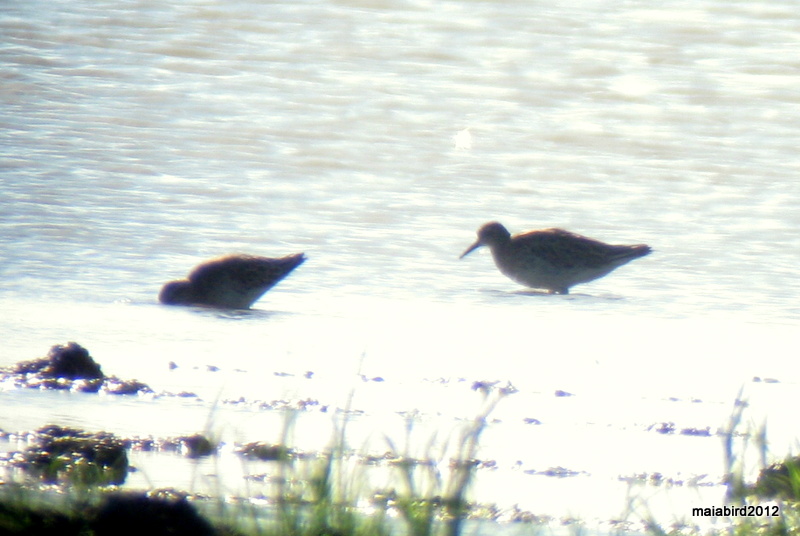
Jops was the only one of us diligent enough to count the birds, and his efforts paid off. He spotted a couple of birds in the water, probing the shallows with their long, two-toned beaks. Jun also noticed them earlier and we concentrated our efforts documenting the birds and trying to identify them. Our best guess was that they were Black-tailed Godwits but we needed confirmation. And confirmation we got! After emailing birder friends Desmond and Felix, we got the same ID: Black-tailed Godwits

The pair of Black-tailed Godwits.

With two unexpected lifers for me and Jops to add to our list (one for Jun), we drove back to Manila with growling stomachs for a well-deserved lunch. =)