Showing posts with label birdwatching in the Philippines. Show all posts

Pink Dethrones Silver

For the longest time, the Silvery Kingfisher topped my list of favorite kingfishers. I first saw one in Bohol before the species was split into Northern and Southern types. Between the two, I've always preferred the Southern Silvery Kingfisher. It has been good to me—showing well every time I’ve gotten the chance to see it.

I lifer-ed it in February 2013 during an ocular trip toPasonanca Natural Park in Zamboanga, and again in 2014 during the 9th Philippine Bird Festival at the same site.

My very first Silvery Kingfisher in Pasonanca in 2013

In 2018, I got lucky again in Tacurong during the 12th PBF and Tacurong Bird Festival. At a later event, I was even gifted a beautiful painting by Tang Tuck Hong of the Wild Bird Club of Malaysia because we shared the sighting during that trip. The painting is framed and proudly hangs on my wall.

Thank you again, Tang, for this beautiful painting!

So yes, the Southern Silvery Kingfisher, with its dark palette and mesmerizing silver spots, reigned supreme on my list. Unbothered about being dethroned… until I found the pink one.

I didn’t even consider the possibility of seeing the North Philippine Dwarf Kingfisher anytime soon. Not even when my good friend Sean posted an AMAZING photo of the bird from one of his trips to Infanta in February this year. I just allowed myself to be jealous about it (and yes, maybe a little bitter haha!) but refused to dwell on the fact that I won’t be able to twitch it any time soon.

Post after post of the pretty little pink-and-orange-y Luzon endemic popped up on my Facebook feed from birder friends who have seen and photographed it. I swallowed the intrigue and kept my head down, focused on work, while it gnawed at my periphery. Until... Vinz messaged asking about a possible “twitch and run”, and I was raring to GO!

Surprisingly, no one had booked Francis (a local guide) on the Sunday we went. We picked him up and his son Mark joined us as an extra spotter. As always with a twitch, the nerves kicked in—more so because we had very limited time for this particular bird. We all needed to head back to Manila right after lunch! It was also the first time Vinz and I were forest birding together. We’d soon find out if we made a lucky combo or if we were jinxed.

We soon parked by the roadside and were slowly making our way down to the site the kingfisher has been seen. Thankfully, it was a very short walk and we were soon quietly scanning the trees for the bird. We stood on a ledge overlooking a slope, the air filled with the sound of rushing water, birdsong, and the occasional roar of passing engines.

Our view for the morning!

After fifteen minutes, Mark and Francis signaled to us —it was there! The tiny kingfisher suddenly perched at eye level, partially shadowed and hidden by leaves. I got a good look through my binoculars, snapped a few photos, and stepped aside so Vinz could view it too. It soon flew off and left us marveling at its quick appearance and my ticking off a lifer! Successful twitch! We were not a jinxed twitching combo! Should we go home now?

Of course not.

We waited for another appearance—and it did come back. This time, joined by a second North Philippine Dwarf Kingfisher, bringing food to feed the other one. 

The pair of North Philippine Dwarf Kingfishers - LIFER!

For the next four hours, we stayed in the area, being entertained by the appearances of the two beautifully-colored kingfishers. We were joined by Lau and we all enjoyed one kingfisher bringing food to the other.


The beauty of these kinds of sightings is that it allows you to observe the birds for a prolonged period of time, taking in all their minute field marks: the fine spots on the head, the ultramarine (ULTRAMARINE!) dots on the wings of the individual bringing the food, and their different shades of lilac, pink, and orange. Even their tiny bright red feet clutching the branches they perched on were a treat to observe. 

Ultramarine spots on the wings!

Such a pretty kingfisher!

Eventually, the kingfishers flew off and, having had our fill of the birds, our group moved on to a Scarlet Minivet nest nearby. 

Female Scarlet Minivet sitting on its nest waaay up high!

We left Lau at the site, dropped Francis and Mark at their house, and made our way back to Manila. We celebrated the kingfishers and our lucky twitching combo with pizza, sisig, and ice-cold Coke in a restaurant along the highway.

Happy twitchers with guide Francis and his son Mark

On the drive home, we reflected on our luck, the sheer beauty of the North Philippine Dwarf Kingfisher, and the feeding behavior we witnessed. It was then that I decided – or maybe realized – that it had dethroned the Southern Silvery Kingfisher from the top spot on my kingfisher list. I thought that wasn’t really partial to pink (most of my clothes are black or some neutral color or with some sparkle) but in this instance, pink trumps silver. Hands down.

Sharing a video of the two North Philippine Dwarf Kingfishers, one bringing the other a nice, big cicada. Enjoy!

The End of My 9-Year Ernesti Wait

There are some bird species that I've always wanted to see ever since I browsed through my second-hand Kennedy field guide 9 years ago. I was amazed then of the concept of "subspecies" or "races" particularly when I saw the 2 races of Peregrine Falcon in the Philippines. Subspecies is the taxonomic category ranked below species level and is designated by a Latin trinomial (3 word-scientific name.)

The more commonly seen race or subspecies of the Peregrine Falcon is the migrant Falco peregrinus calidus which I was lucky enough to see in my first year of birding, specifically on July 27, 2010 in Mt. Palay-palay (before the tunnel was blasted through the mountain and the forest turned into a highway.) Thank God, I kept all my birding notebooks!

The migratory Falcons have always been kind to me. I've regularly seen them in nearby areas throughout the years. In UP Diliman, in Ateneo, along Quezon Avenue, along Commonwealth Avenue, in IRRI in Los Banos, and even in a communication tower viewed from our house in Quezon City. But I've never got the chance to see the OTHER race which is the resident ernesti subspecies.

For 9 years, I waited for a chance to see these dark and handsome raptors. Then, without warning, fellow birder Mhark G. shared photos of a family of ernesti falcons in Rizal! Things happened quite fast and Djop and I soon found ourselves with a golden opportunity to go see one of my most-wanted birds!

Looking back at the rest of our party in the early part of our climb.

Let me just say that this twitch to see the ernesti falcons was... unforgettable. The trail we took was a new one, made by Mhark and the local guides to get to a good vantage point which was 100 meters across a gorge away from the nest. The path we took was limestone and mud (because it rained hard the night before.)

Most of the trail was this... no trail really.

I feel very blessed for the attention and care Mhark and the local guides gave us while we were traversing jagged rocks and narrow ledges. I was also very grateful for the pair of gloves available from the guides which allowed me to use my hands to grasp and crawl whenever possible.

Early in our climb, the Falcons already showed themselves, flying by and showing us they were indeed the world's fastest fliers! But they were too far! We trudged on, with somewhat more urgency and excitement to see the birds.


Mhark assisting me and Kuya Let ready to catch me!
Photo by Djop
At some point, the only option was to tread on a makeshift one-branch "bridge" while holding on to the rock face. I never thought I would do something like that... but I did!

I stopped bringing out my phone and taking photos and just concentrated on getting over and past obstacles in the trail. I took comfort in the fact that there was help whenever a stone looked too large or the trail too narrow or sloped for me to walk through by myself.

We saw the Falcons a number of times before we reached the observation site. First, one Falcon perched on a rocky ledge but quite far away and heavily back-lit. It stayed a while and we all took the chance to photograph it even though the photos wouldn't come out so good..

The next sighting was a lot nearer to us! It stayed perched on a small leafless tree and we were almost directly under it! Getting a clear view was a challenge since the path was very narrow.


Finally! A clear shot of the Falcon!

The young Falcon flew away after a few minutes, noisily calling as it transferred to a different perch. This was where we got lucky! It didn't go far! And with a bit more climbing and correct positioning, an open shot was possible!

Sir Alain, Mhark, Djop, and I took our places on the steep trail and took photos. Sir Roy chose to stay at a lower part of the trail and Sir Bert's camera was unfortunately brought to the observation deck ahead of him.

At that point, I really don't know how I was able to climb all to where I was. The limestone were directly in front of me and there was no way else to move but by hoisting myself up the sharp rocks and getting on the next "level" of rocks! I guess adrenalin does work in these kinds of situations.


There were actually 2 Falcons in that spot, but the other at a farther and much higher perch than the one we were photographing. It stayed quite a while, allowing us to take lots of photos and admire its handsome features.

Peregrine Falcon (Falco peregrinus ernesti) - immature

Peregrine Falcon (Falco peregrinus ernesti) - immature

The raptor then spread its wings (which I got a blurred shot of!) and flew off from its perch. I reviewed my photos and said a short prayer of thanks for this amazing opportunity! I was good! I told the group I would now head back down to join Sir Roy while the rest could proceed to the observation site. Alas, I was convinced by everyone to trudge on and make the last effort to the site. "Konti na lang, ma'am!" "Sayang naman, ma'am, andito ka na!" "Five minutes na lang, ma'am!" 😂

Last effort indeed as the final climb involved pulling myself up the slope with ropes until I finally landed on the ledge and rested my tired body on a bench they had made the day earlier. As I slowly felt my heart slow down, I found myself looking at the rock face where the Peregrine Falcons had nested. The young ones have all fledged now but it was amazing seeing it all the same.

We soon had lunch brought to us: binuhong manok (native chicken cooked in bamboo), pinakbet, and rice! We also had boiled eggs and they brought up ice so we could cool our water.

Hot lunch up the mountain!

After lunch, we all got sleepy... what with the delicious lunch and the mountain breeze! I managed just a few minutes napping, mainly because I was afraid to go tumbling down the mountain side and also because the guides would point out the Falcons as they flew overhead us from time to time.

The whole afternoon was spent waiting for them to perch closer to their next but unfortunately they didn't. However, we did get an amazing display of the adult Falcons "teaching" their young to hunt in the air!!! My camera could not possibly photograph the spectacle before us, but I borrowed some photos from Djop of the parent clutching a pigeon in its talons, hovering above us, waiting for the young Falcon to grasp the prey from underneath! I really have no words to describe it properly!


The wind picked up very quickly soon after we saw the Falcons' "training" exercise. We all didn't want to go down the mountain in the rain, so we packed up our day camp and began our descent. Djop said it took us around 30 minutes to get back down. I was at the front of the line and I swallowed my fear and just made my way through rock, soil, and non-existing trail back to the community. My legs were shaking visibly when we got closer to the houses, we took a short break and a wave of nausea slowly creeped in. I shook it off and followed the group to the community where Sir Roy was waiting. 

As I sat down on the wooden seat, I began to relax and the nausea quickly left, but then I started feeling tingling in my fingers and my upper lip was going numb! Prof Bert told me I needed sugar and offered me a mint which I gratefully took and it worked! Sir Roy had ordered halo-halo for the group (perfect!) and as we ate our yummy reward, the rain fell.

This was yummy halo-halo!!!

When the rain slowed to a drizzle, we headed back to the parking area through the last set of steps, which I went through with SO much difficulty since my knees refused to bend!!! We said our goodbyes to our local guides, who after what we've been through and how they helped me, I now consider my friends. I insisted for this group photo to forever immortalize one of the most memorable twitches I've ever done! Maximum effort! 💪

Sasmuan's Surprise Spoonbills

I am very grateful to have been given the opportunity to participate in two counts for 2019's Asian Waterbird Census (AWC) in sites I've never been to before. As always, the experience of visiting a new place in the Philippines is unforgettable and will forever be shared with the people alongside me.

The first count I volunteered for gave a surprise sighting that even made it to the front page of the Philippine Daily Inquirer! I've joined in a number of bird counts and surveys of Manila Bay with Arne Jensen, the Records Committee Chair of the Wild Bird Club of the Philippines and an associate expert of Wetlands International but I've never been to the count site I was assigned to last January 12. Djop and I were assigned to join the team of Mads and Lu-Ann Bajarias to count in Sasmuan, Pampanga which included Bangkung Malapad.

Boardwalk entrance of SBMCHEA

Our jump-off point was the fish market in Orani, Bataan so our team of four was already on the road before 3:00AM. We arrived in Orani and was met by Freddy, our boatman for the trip. We wanted to be at Bangkung Malapad by sunrise so we boarded our katig-less banca in the dark and headed off to Manila Bay.


As our surroundings became lighter, we were joined by groups of birds skimming the surface of the water around us. It was a such beautiful dawn!

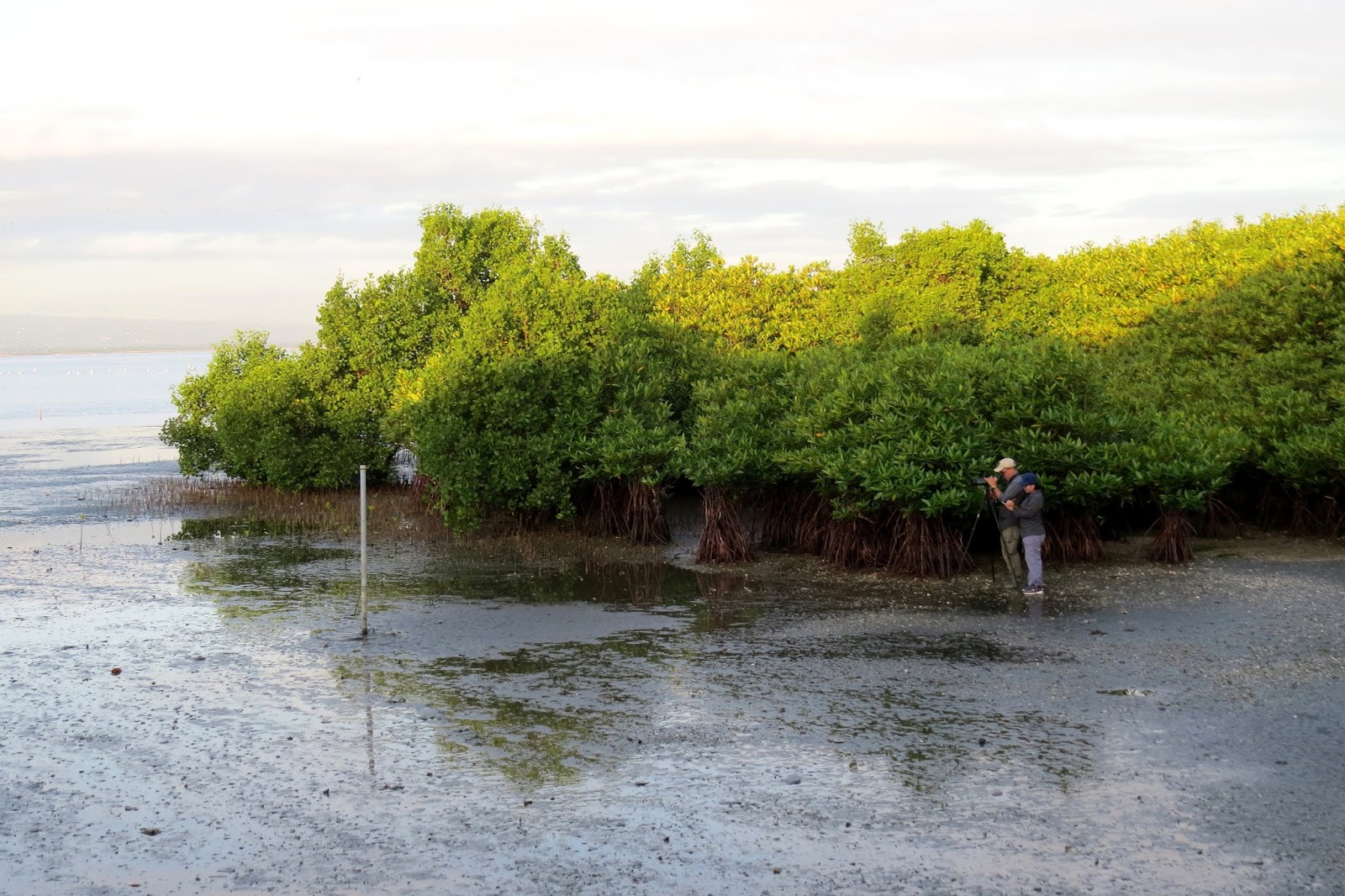
We were soon approaching the entrance to Bangkung Malapad. Bangkung Malapad, also called the Sasmuan Bangkung Malapad Critical Habitat and Ecotourism Area (SBMCHEA) is a small islet in Manila Bay and boasts of mangrove trees and mudflats where migratory birds can be found.

View from our banca as we approached the entrance to SBMCHEA

Walking through the mangroves to the view deck.
As we got to the viewdeck, we all began setting up: scopes, cameras, food... when I saw three heavy-ish birds flying our direction. My heart skipped a beat when I noticed their distinct heavy bills so when I raised my binoculars to confirm what I thought they were, I couldn't contain my excitement and exclaimed loudly to the group: "Spoonbills!!!" In my excitement at this completely unexpected sighting, I struggled finding the "Black-faced" portion of their name, spinning in place as I forced my brain to cooperate. "Black-faced Spoonbills!" I finally managed to say. I looked at my friends and was even more delighted to know that all of them saw the spoonbills and that they were lifers for Djop and Mads (yay!), and a country lifer for Lu-Ann (yay!)!

The trio of Black-faced Spoonbills flying against the pinkish sky

The spoonbills flew around the view deck a number of times, giving us great views and chances for photographs in our slowly brightening surroundings. We thought (and hoped and prayed) that they would land in the mudflats right in front of us, but sadly they did not and instead flew away behind the mangroves and out of sight.

That's the view deck as photographed from the mudflats

Djop scoping out birds out on the mudflats from the view deck
The spoonbills did not make any more appearances the rest of the day but we did get to see quite a big number of other birds: Black-headed Gulls, Great, Intermediate and Little Egrets, Asian Golden Plovers, Gull-billed Terns, Whiskered Terns of course, and some Caspian Terns. We were soon joined by counters from the DENR, DOT, and WBPP and we scanned and counted the further sides of the mudflats which are covered by the mangroves if you stand on the view deck.

That's Mads and Lu-Ann counting by the mangroves

That's me and Djop counting from the mudflats
Thank you, Lu-Ann for the photo! =)
After we counted the area of birds, we said our goodbyes to the rest of the team, boarded our banca and headed off to our other count spots in the area. Sadly, there weren't much to see in the stops we made save for feeding flocks of Whiskered Terns and egrets. We did pass by a small group of Black-winged Stilts but not much other waders.

We made our way back to Orani, stopping by a large expanse of exposed mudflats which held quite a big number of plovers. The mud was too wet and mushy for us to stand on for better views, so we took note of the site (no longer in Bulacan) and went back to the fish port. We collated our data over lunch and drove back to the city with a total of more than 9,000 birds for our count. The number was quite low but not bad, plus we had a mega record sighting of the Black-faced Spoonbills too! Black-faced Spoonbills are globally endangered and our sighting last January was the first in more than 100 years since it was last recorded in Manila Bay.

With more and more birders looking at the birds in different areas in Manila Bay, hopefully the efforts to protect and conserve it will pay off. And hopefully, with sightings such as the Black-faced Spoonbills among other birds, there is more than enough justification for the protection of the habitat, not only for the birds and other wildlife, but also for humans too.

Happy AWC volunteers! =)

A Unicorn on All Saints' Day

Just days after I blogged about how my unicorn bird, the male Narcissus Flycatcher, has eluded me after another attempt at finding it... I saw it.
I was working on my blog post about my recent trips up to Bangkong Kahoy when I decided to give in to the inner twitcher in me and take my chances to see the Narcissus Flycatcher. It was seen and photographed by friends in the Redemptorist Church in Baclaran the previous day (and they had AWESOME photos!) I took an early morning train to Baclaran and after a short walk was inside the church compound looking for the coffee shop and the patch of trees where the Narcissus was said to frequent.
The Redemptorist Church, which is also the National Shrine of
Our Mother of Perpetual Help,
and more commonly called the Baclaran Church

I immediately knew I was in the right area when I saw the huge cameras and people in varying shades of green and brown looking up at the trees. I entered the Sinirangan Coffee Shop and greeted friends, old and new. After learning the bird hasn't shown up yet, I ordered my coffee (and an ensaimada to be claimed when I saw the bird.) I sat down beside Sir Chin (who was very relaxed, having photographed the bird already the previous afternoon hehe) and chatted a bit. I brought out my binoculars and scanned the movements up in the trees. I spotted a  flycatcher far up a tree and thought it was a female Narcissus Flycatcher. Sir Bert and Sir Roy decided to go in for a closer look and saw it was a Ferruginous Flycatcher! What an unexpected bird to see! But still not what I was after =P
More people arrived to try for the Narcissus and I was getting a bit anxious. Will I miss out on it again?
Waiting for the bird

And then... Sir Chin was gesturing for me to come closer and pointed to the trees in front of him. It was there. I put down my coffee cup and tiptoe-ran towards him. I pulled out my bins and voila! My unicorn!!! I took in all its details... the yellow and black, the whites, the bill, the eyes, the tail, the wings. After six long years, I was finally looking at the male Narcissus Flycatcher. I took out my camera and got some horrible back lit shots!


The bird flew around us and was very skittish because a Brown Shrike was chasing it! I really did not want to see my much-awaited lifer get torn apart by the butcher bird just minutes after seeing it! What a horrible story that would be!


Thankfully, the Brown Shrike let it be for a while and it stayed in the area. It flew around the courtyard and even perched low, giving us many amazing views and opportunities to photograph it. I know I could've gotten more and even better photos of the bird but I am content with my "haul" for that morning. After all, I waited six years to see this bird and it showed itself very well (plus it did not get eaten by the shrike!) Hooray!

  
It perched very low at times!

My favorite shot, as usual, gives the feeling of
looking through the leaves to see the bird =)


Thank you, Mr. Narcissus! It's been a great 6-year adventure chasing you. Now, time to find a new unicorn to chase ;)
(Oh, and yes, I did claim my celebratory ensaimada after seeing the bird.)

The Unicorn Remains

I’ve been wishing to see the male Narcissus Flycatcher for years. Five years to be exact. I’ve actually seen the female back in 2011 and have always dipped on any attempt to see the male, sometimes missing out on the bird by a few minutes. Yellow and black, the male Narcisuss Flycatcher is much more striking than the brown female but its elusiveness has earned it a title of “Unicorn Bird” — as if it was a mystical creature that doesn’t really exist (and is also a rationalization for those of us who have continually missed out on seeing it.)
Recently, a number of male Narcissus Flycatchers have been seen and photographed in different locations: Baguio City, Manila, Quezon, Palawan, and also in nearby LPPCHEA (Las Pinas-Paranaque Critical Habitat and Ecotourism Area.) So I went with Chin and Mark to LPPCHEA and try my luck there (plus I’ve really missed seeing waders!)
The tide was quite high but there were some exposed sandy parts of the beach.

We decided to skip the beach and go straight to the trails and try to find the Narcissus Flycatcher. As we were registering with the DENR personnel, he pointed out a young Reticulated Python coiled up on a low branch in front of the birdwatching station.

Reticulate means “resembling a net or network;
especially :  having veins, fibers, or lines crossing”
(www.merriam-webster.com)

We entered the trail and kept our eyes open for any movement around us. There were a lot of Philippine Pied Fantails and Arctic/Kamchatka/Japanese Warblers flitting around the trees. I saw a large-ish bird and recognized the tail of a cuckoo but the bird flew as soon as a Brown Shrike called! Further down the trail, Mark spotted the cuckoo and we were able to observe a beautiful hepatic Oriental/Himalayan Cuckoo feeding on a tall tree.

Oriental/Himalayan Cuckoo

We observed the cuckoo for a while until it disappeared from view and we refocused on finding the Narcissus Flycatcher. We went deeper into the trail and more birds were coming out. Golden-bellied Flyeaters and Yellow-vented Bulbuls came in big groups to feed and Grey-backed Tailorbirds sang unseen around us. As we slowly walked the trail, Mark suddenly pointed out a bird, busy whacking a worm on a tall branch: Blue and White Flycatcher!

Blurred photo but I’m happy the bird’s colors can be seen

We didn’t expect to find this bird! But there it was, busy with its meal! After eating the worm, it adjusted its perch, looked around, and flew away. Lifer! We trudged on, still looking for the Narcissus Flycatcher. We were nearing the end of the trail and I managed to spy a Yellow Bittern through the leaves near the first pond.


There was a big group of students at the birdwatching station and Mark pointed out the python to them. They also swarmed around Chin, curious about his attire and gear, asking if he was a soldier ;)

Mark being swarmed my students

Sir Chin's turn to be swarmed with students 

The girls moved on and so did we to the beach. There were some egrets by the water’s edge and some large waders foraging in the sandy trash (or trashy sand.) Upon closer inspection, more waders came into focus! Whimbrels, Pacific Golden Plovers, Kentish Plovers, Common Greenshanks, and Common Redshanks walked along the beach searching for food. We also spotted one Chinese Egret on the beach as well as a couple of Terek Sandpipers and Bar-tailed Godwits!
  
Bar-tailed Godwit

Pacific Golden Plover (foreground) and Common Redshank (background)

Chinese Egret (L) and Little Egret (R)

Can you spot the Terek Sandpiper?

Whimbrel

We also spotted a huge flock of Red-necked Stints that would fly across the water and land on the shore again. Among the stints were some larger and whiter birds… my second lifer of the day: Sanderlings! I missed seeing them in LPPCHEA years before and I was thrilled to finally tick them off this year! They stayed long enough for me to study their markings and compare them to the other waders beside them.

Stints on the move!
 
Bad photo but I can see a Sanderling there!!!

We decided to move towards the main road and hope for a better vantage point but we didn’t get better views. We returned to our original spot and after some more time with the waders decided to try one last time for the Narcissus in the trail.
Let me just say that after rounding the trail one more time, the Unicorn remained a Unicorn and the closest I ever came to seeing a Narcissus that day was in the colors of this insect.


‘Til my next attempt, Unicorn Bird.