T'was six days before Christmas when our fellow birders
Brian E. and
Linda G. reported a pair of
Black-faced Spoonbills in Candaba, Pampanga. Alas, it was a Thursday and as much as
Jops and I wanted to twitch the birds, we had to wait for the weekend to do so. I was very excited to get a chance to see them especially since our birder friend Nilo A. spotted and photographed a single Black-faced Spoonbill in Olango Island in Cebu just a few weeks ago!
Come Saturday, Jops, Jon V., and I headed to Candaba early morning to try our luck with the spoonbills. We made it to the area and immediately saw our birder friends Peter, Tito Bob, and Tita Cynthia. They had spotted the birds and
Tito Bob had already gotten a photo! The birds were still there!
 |
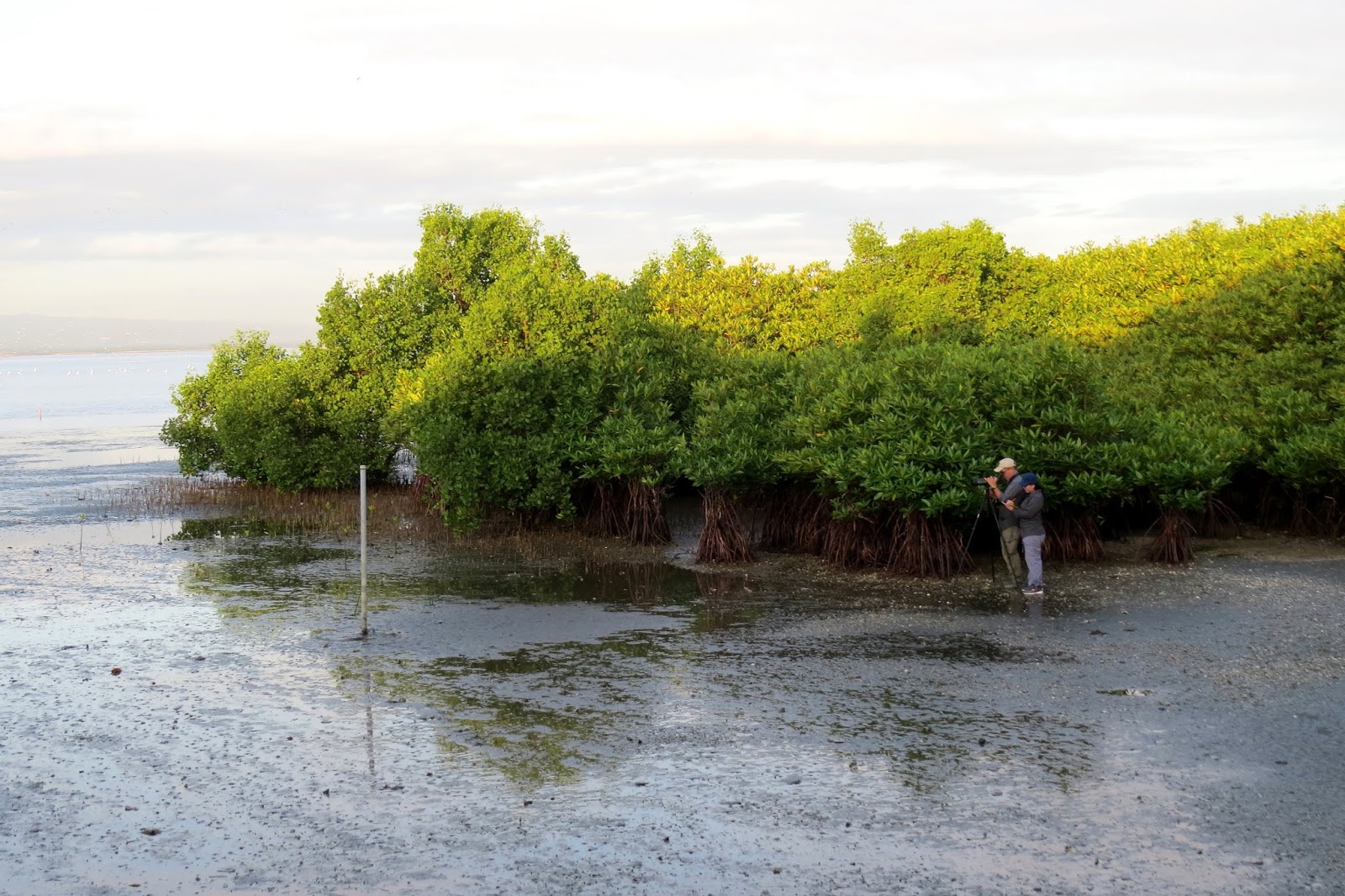
Under a pretty Candaba sky, birders old and new, spent part of their
morning birdwatching |
We immediately got the scopes out and started scanning the scattered group of egrets, herons, and waders on the ponds in front of us. After a few seconds, Jops said quietly, "I got them on the scope." After he got good views, Jon and I took turns looking at our awesome lifer, making sure to see their black faces and spoon-like bills. Lifer!
We followed the birds as they walked towards the left, then towards the right, busily foraging for food with their heads down. It was challenging enough getting photos with the birds so far away, and their constant movement and foraging made it even more difficult to get a decent picture of their heads!
 |
| Here's a shot of the spoonbills preening in between furious foraging |
 |
Here's the best shot I got of our awesome lifer!
Grainy, but it shows the features of the bird well enough =) |
While trying my luck getting a documentary shot of my awesome lifer, some locals came over curious as to what we were all excited about. Joggers, bikers, and kids, all got to see the pair of Black-faced Spoonbills having breakfast. I guess they didn't realize it, but we tried our best to explain the significance of having the birds in Candaba.
The pair of birds we were looking at were part of the small global population of Black-faced Spoonbills. Listed as endangered, there is an estimated population of more or less 2,000 birds left in the wild. There is a recorded historical population of 10,000 birds but their numbers plunged to 288 individuals in 1988. But with conservation efforts, the population was able to slowly recover to 2,693 birds in 2012.*
After a while, our group decided to move to the area near the Mayor's ponds and try for the Siberian Rubythroat. It would be another lifer for me and Jops, and we were hoping our lucky streak would continue.
The roads to the Mayor's house were dry but there were some portions with very deep potholes. We stopped beside an area with pretty vegetation which also head a small number of waders:
Wood Sandpipers,
Long-toed Stints, and quite a number of snipes were seen.
 |
| Long-toed Stint |
We then moved on to the huge pond and saw that it was almost completely covered with vegetation! Lots of
Wandering Whistling Ducks could be seen landing on the water and disappearing in the plants. A lot of them were perched out in the open too.
 |
| Two very handsome-looking Wandering Whistling Ducks |
Jon, Jops, and I pushed forward to the Mayor's house but didn't see the Rubythroat after several tries calling it out from the brush. We got some replies but the bird never came out. We regrouped with Tito Bob and getting a helpful tip from Mike A., we positioned ourselves in the area where they saw it last week. After several attempts at calling the bird out, we heard one answer loud and clear. Jon then saw some movement in the brush and there it was, our second amazing lifer for the day: a gorgeous male
Siberian Rubythroat.
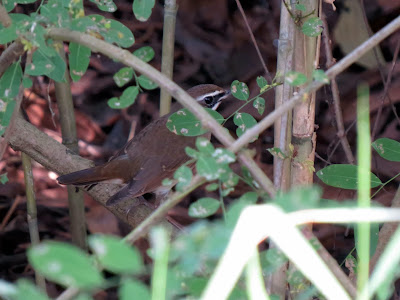 |
At first, it had its back turned to us.
Who would have thought this brown bird would have a ruby-red throat? |
We think there were at least two individuals in the area we were in but the birds never came out in the open. We did get good views, obstructed here and there by thin twigs and dried leaves. I didn't get a clear photo but these blurry pictures are enough souvenirs of another memorable lifer.
 |
I am still amazed at this perfectly-named bird!
The red on its throat is a deep ruby shade lined with black. |
 |
The white stripes add a different accent to an otherwise
all-brown bird. |
The bird would skulk in and out of view, making it very hard to get a photo. I was lucky enough to see it calling half-hidden in the dry brambles at one point before it disappeared quickly from view.
It was midday all too soon and we all had to go. Good byes and Merry Christmases were exchanged and we all drove out of Candaba happy. In the car and over lunch, Jon, Jops, and I were still ecstatic over our successful twitch, overwhelmingly happy that we got to see both the Black-faced Spoonbill and the Siberian Rubythroat in one morning. From the looks of our successful Christmas twitch ticking off the "Spoons" and "Rubies", 2014 is having a pretty good start. =)
* Data from BirdLife International's Fact Sheet about the Black-faced Spoonbill.
Post-script: The sighting of the Spoonbills has been featured in an article in local news!