Showing posts with label birdwatching in Candaba. Show all posts

Hopeful for Candaba

It was a great morning to go birding. The skies were clear, the sun was up, and a cool breeze was blowing. All that was lacking were the birds.

The Mayor's pond still housed a number of bird species but the vegetation
was so thick, it was almost impossible to see most of the birds

January is Asian Waterbird Census "season" and I was happy that Djop and I were able to volunteer again for this year's Candaba count. The AWC in Candaba last year yielded a total of 6,466 waterbirds counted but things were looking a bit gloomy for the site for the 2018 count. Recent reports from fellow birders described the place as being overgrown, with many parts converted to rice fields which meant birds were few. I personally braced for a dismal count... and that was what we got.

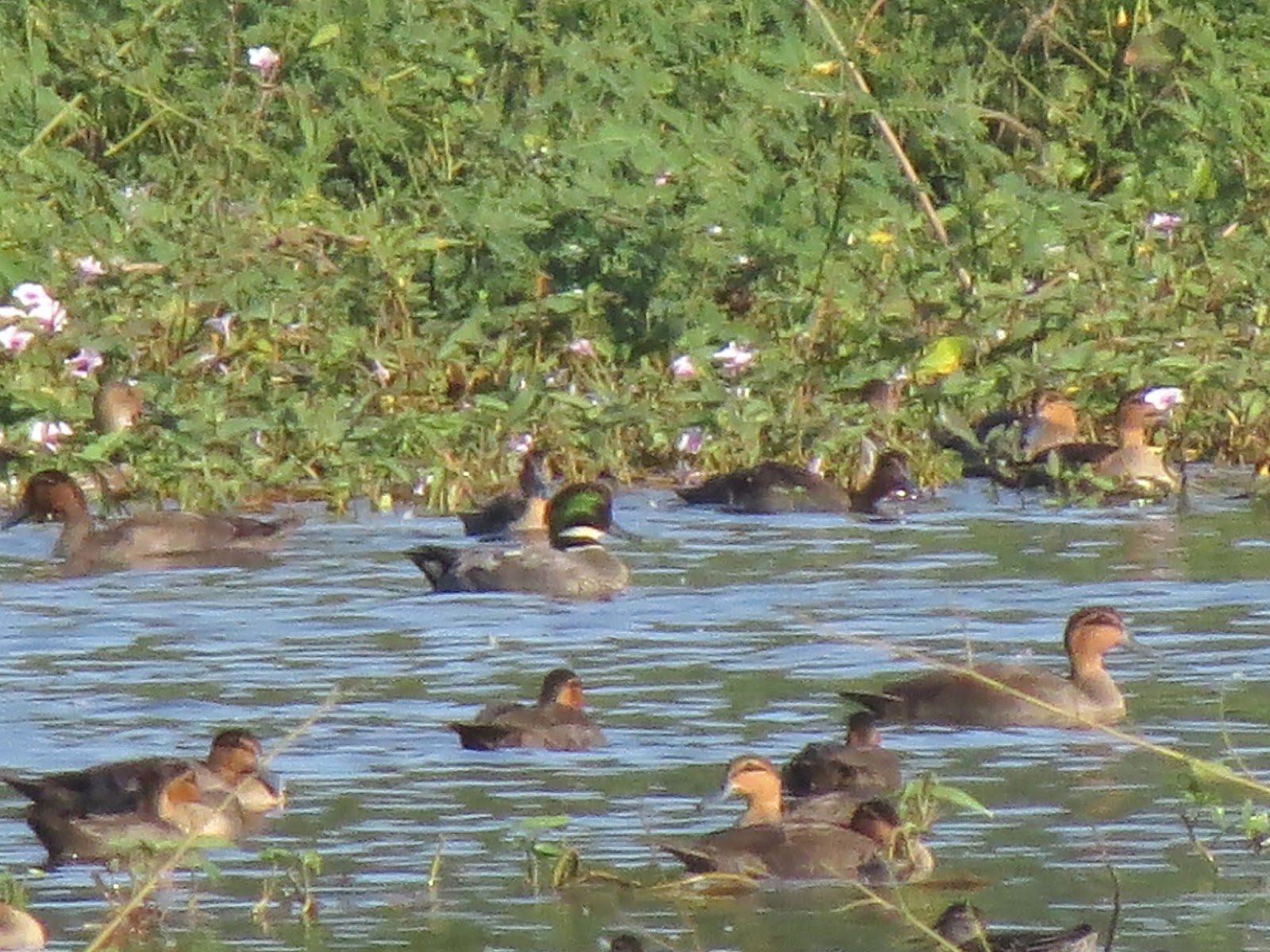
Find the ducks!
This was the most open patch of water in the pond that we spotted that morning

The 2018 AWC in Candaba had a total of 1,449 waterbirds counted, the largest numbers of which were the Black-crowned Night Herons (259) followed by the Purple Herons (226.) The sad numbers of ducks and even species of ducks seen, I guess, are the best evidence of how the place has turned for the worst.

The Black-crowned Herons were one of the most visible birds in the
Mayor's pond that morning

Can you imagine only  120 Garganeys, 40 Northern Shovelers, 12 Wandering Whistling Ducks, 54 Philippine Ducks, and only 1 female Northern Pintail counted? Even the plovers and sandpipers were in very low numbers, the total population counted for that morning not even going over a hundred.

Candaba "bird-scape" January 2018:
A far cry from the hundreds (even thousands!) of ducks
that used to take flight over the Mayor's pond
A lone Wandering Whistling Duck settled in an open spot of water,
the rest were hidden in the vegetation
Our team scanned and scanned for any more birds that could be seen and
counted for the census

I could go on and on about how bad the situation is in Candaba now, especially since I've seen it in better, more birdy-er days BUT it's a new year! And as I spoke briefly to former Candaba Mayor Gerry Pelayo, I saw a faint glimmer of hope and I think things may be looking up for Candaba. It's going to take careful planning, close coordination, and consistent implementation, but the wheels are in place and are ready to start turning, MAYBE there is real hope for Candaba's ecosystem to be restored to it's former health and beauty. We have to wait and see and hope for the best. 

Counting Non-Ducks

The dates for the 2017 Asian Waterbird Census (AWC) were up on the Wild Bird Club of the Philippines e-group and I found just one schedule that I was free to volunteer for: Candaba. I haven't been back to the site since I twitched the Falcated Duck and Baikal Teal last January 2016! Yes, one whole year ago!!! I signed up and was raring to go and count hundreds of birds in the marshland.

I've read the reports of birders who have visited the site last December saying that the ponds were overgrown and you couldn't see the ducks. I was hoping it wasn't THAT bad, but sadly, it was. Here are some photos I took over the years of the Candaba landscape to give you an idea of how much it has changed...
This photo was taken in January 2012

Mayor's pond in January 2015

And this is mostly what the area looks like now...

January 2017 - This used to be the pond behind the Mayor's house
(see the "tower" on the right side of the photo)

The big pond is now choked with vegetation and the surrounding areas converted to rice fields. I looked around at the count site and was saddened by how much it has changed. But, we had a job to do and so we got right down to it. But not before we got distracted by an Eastern Marsh Harrier patrolling the big pond.

Eastern Marsh Harrier (and Purple Swamphen?)

We made our groupings and assigned areas to each group and went our separate ways. The WBCP volunteers were joined by DENR personnel and LGU representatives.

Bob taking the lead before we headed to our different areas =)

I was grouped with Art, Riza, and Patty and we were joined by Ian from DENR. We drove to the back ponds and started scanning our area. There weren't really much birds since the land had been planted with rice already. Through the scope, I spotted some movement on the ground and hoped for waders, but the birds turned out to be Red-turtle Doves which seem to have proliferated in the area.

Art pointed out that there were some ducks near the old hut in the middle of the big pond and since we were done scanning our side of that particular area, we pointed our scopes to the small patches of water peeking from the plants. True enough, the ducks were there but it was very difficult getting any clear views! I saw there almost all of them were Philippine Ducks and I spotted a male Northern Pintail and some Garganey. I was beginning to get dizzy straining my eyes to see more details and spot more ducks so I tore myself away from the scope and we proceeded with our count.

Maybe if I squint really hard, the ducks will come into focus better!

Sadly, we saw more grassland birds than waders all the way until we came up the concrete highway. We did count some Little Ringed Plovers, some Kentish Plovers, a couple of Long-toed Stints, and some Common Sandpipers.
Let's play "Spot the Plovers"!

There were quite a number of Barred Rails, White-browed Crakes, White-breasted Waterhens, and even a Buff-banded Rail came out to preen. We had good views of Philippine Coucals and a Lesser Coucal while the Chestnut Munias and Striated Grassbirds were in abundance among the tall reeds of grass on both sides of the road.
Riza, Art, and Patty counting egrets far, far away.

Soon, there was nothing left to count. Zero ducks in our site, though we did see a lone Little Grebe on our drive back to the Mayor's house.
A silhouette of a Little Grebe in very harsh light

We drove back to the Mayor's house and waited for the other teams to arrive so we could tally our numbers and get the total count for this year's AWC. Not surprisingly, our counts were quite low given the change in the habitat.
There were some big numbers of non-ducks in our list. Some.

Our total for that morning reached around 2,600. But that isn't the final count as figures from the ponds in the mayor's other property haven't been tallied yet. I'm hoping the number of birds counted this year isn't too low compared to last year's count (around 5,000) but I'm not keeping my hopes up... The highest count I've experienced participating in in Candaba was in 2012 with a high count of 10,456 while the lowest was in 2013 with a count of 1,631. Let's see. I shall bite my nails anxiously awaiting our final total and seeing what becomes of the Candaba bird sanctuary and marshlands.
My team for this year's count: Patty, Riza, and Art =)

Update: The final tally just came in! The total count for the 2017 Candaba AWC is 6,466!


The Lifer Remedy

I ticked off two mega lifers within 30 minutes of arriving at the site and I was struggling to remember their names. I took photos, looked carefully at all their field marks, but as I held my pen to write them down in my notebook... I just couldn't remember their names!

The sun wasn't up yet when I saw my first lifer...
It was just starting to get bright when my second lifer
was spotted! Can you see it in the middle of the photo?

The night before, I got confirmation the trip to Candaba was a go while having dinner and drinks with Mark and Rob. And that was after we finished a Crossfit workout. The workout was intense (and the first time I've tried it) and dinner and drinks lasted the whole night, so... fast forward to the following day in Candaba, my head was cloudy, on the verge of having a headache, and my body ached all over.

But as the sun rose and I got even better views of the birds and the landscape, my head started to clear.

Flocks of ducks would take flight, filling the air with the
sound of their wings. Awesome!

By the time the sun was up, my mind was waking up and I was gaining more movement in my limbs. We met some bird photographers and another group of birdwatchers and showed them the ducks. I FINALLY got to remembering the ducks' names and made sure to write them down immediately so as not to forget! I kept borrowing Christian's field guide earlier to check the names!

The Falcated Duck (my first lifer of the day) was out of sight but the Baikal Teal was preening continuously in the vegetation almost the whole morning.

As the sun fired up the morning, so it did my neurons. I was finally alert and as I watched this duck which found its way to the Philippines for the first time, even the pain in my limbs began to disappear.

Baikal Teal's head popping out of the vegetation.

I was finally functioning 100% mentally by mid-morning and felt only minimal pain in my legs. We shared food and stories in lulls between watching the birds: Philippine Ducks, Garganeys, Northern Pintails, Northern Shovelers, Eurasian Wigeons, Wandering Whistling Ducks, Tufted Ducks, and some Gadwalls.

Duck, duck, teal!
Cereal for breakfast and pasta for lunch!

Aside from ducks, other birds seen include egrets, Purple Herons and Grey Herons, Yellow Bitterns and Cinnamon Bitterns, Common Moorhens, and some Eurasian Coots. A flock of Black-winged Stilts flew back and forth over the pond and Siberian Rubythroats and Middendorff's Grasshopper Warblers sang hidden in the tall grass.

One of the Eurasian Coots came paddling out in a patch of
water near the road.

Both of my lifer-ducks showed even better later on, giving us out in the open views.

In better light, the green sheen on the
Falcated Duck's head is clearly seen.
(That sounded like a Dr. Seuss line!)

We also learned a new word! "Falcate" is an adjective that means "hooked or curved like a sickle" which describes the curved feathers on the Falcated Duck. Unfortunately, they aren't obvious in the photos because the curved feathers aren't so prominent in the individual in Candaba.

We did see the falcations on the duck later through the scope.

The Baikal Teal also kept us under the midday sun when it decided to perch centimeters above the water to preen. Still too far for a great photo (except if you're Mike A. ;) ) but I was really happy we got to see its legs (which was Ruben's request earlier that morning.)

The Baikal Teal sat in the shallows for some time...
... before it inched its way up the vegetation to preen.
Ruben (and the rest of us) got to see legs!!!

The heat intensified after lunch but Rob spotted one more special duck for us that day: Eastern Spot-billed Duck! It wasn't a lifer for me since I've seen it in Taiwan before, but it was a Philippine lifer so it was still very exciting! After some serious discussion on what to do next, our group decided to drive through the back ponds on our way home. 

On the ride home, it was as if the effects of the workout and drinks the night before never existed. I was alert with no headache (yay!) and my body wasn't in pain anymore! Birding with friends and seeing those lifers was the best remedy for a hangover and post-workout pain. 

Too bad the effect has worn off now and the pain is back but... I still got those lifers ;)